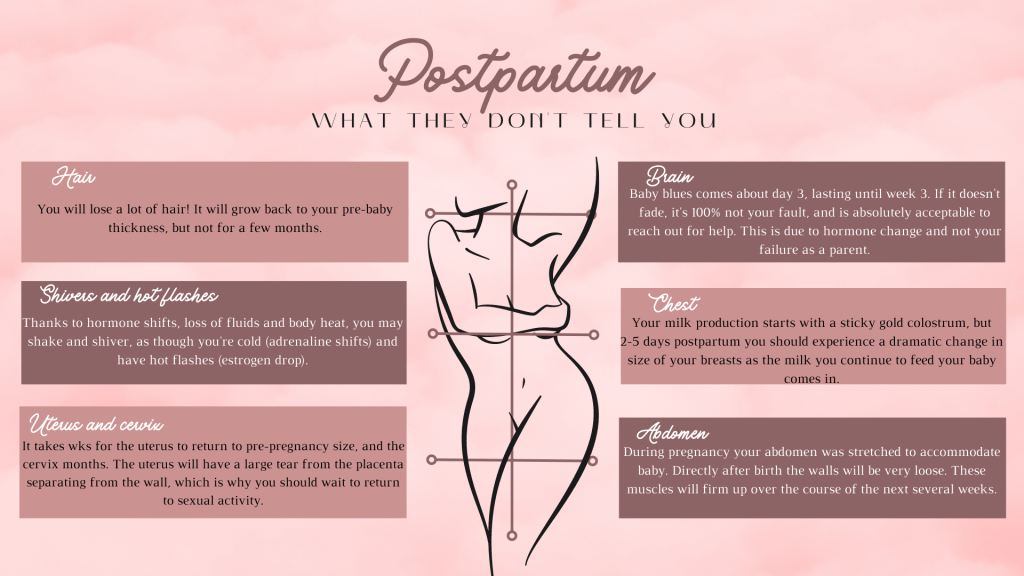
You’ve possibly heard you won’t sleep the same once your baby is here. You’ve been told a million times that your heart will grow exponentially at the birth. You might have been told that the newborn stage is full of ups and downs. But there are things people don’t talk about, or perhaps forget in the fog of parenting, to mention. For instance, you’re going to lose all the hair that you didn’t shed while pregnant. This is quite possibly going to make you feel like you’re going bald. If you’re eating enough, and drinking plenty of water, this absolutely isn’t the case. (And if you’re trying, but not getting the perfect amount of calories/water, you’re probably totally fine, too!)
Guess what! You know when you were in labor and you couldn’t get cool enough sometimes, and then you couldn’t stop shivering? Well, that shift in hormones that caused that is still happening during postpartum. You’re likely going to sweat profusely! Welcome to the precursor of menopause. Postpartum hormone shifts are wonky! One minute you’re shivering and the next you’re throwing off covers that are within a foot of you. This is the adrenaline of labor, the drop in estrogen, and the loss of blood and bodily fluids that happen from birth. You may find yourself waking in the middle of the night covered in sweat and wanting a fan, even in the winter, or possibly sweating so much that you need a change of clothes, while some find themselves only mildly uncomfortable. These are all variations of normal.
In roughly two weeks, maybe a little more or a little less, your uterus will be tucked behind your pubic bone again. Your cervix will take a bit longer to go back to pre-pregnancy shape and may even remain open slightly. These things combined are the big reasons why you want to wait for postpartum sex. The cervix being open means pathogens can enter easily, and the wound from the placenta gives a bullseye to those pathogens. It will take roughly 6 weeks for the wound to heal in the uterus from the placental separation. This is relative to how you treat your postpartum body. If you’re lifting heavy things or not resting when you should you’ll find your bleeding to be heavier and longer than a person who does things in moderation.
Of course, when your hormones drop from birth, it doesn’t just affect you physically. Your mental state will also be affected. Around day 3 you may notice a sort of sadness looming over you. It should pass by week 3. It’s a shift in the chemistry in your brain and body, and totally normal. If you notice that it comes around week 3, or lingers beyond week 3, this could be PMAD (perinatal/postpartum mood and anxiety disorder). This is nothing to be ashamed of and is completely treatable. Reach out to your doula or your care provider for assistance and referrals as needed and know that you are not alone! It’s absolutely true that you can be in love with and beyond thankful for your baby and still suffering from PMAD. 20-25% of parents (both partners, not just the birther) suffer from this.
You’ve possibly heard of “milk coming in,” but may not have heard of the massive change it brings to your body. Your chest may become larger than it’s ever been. You will likely notice that any noise similar to your baby’s cry will illicit extreme milk production once your body switches from colostrum to milk and for a couple of weeks postpartum. You may experience a sensation during let-down where you feel your milk dropping into the alveoli, and for a few parents you may also experience a hormonal change that may make you feel anxious or upset while let-down is happening. For some this occurs often while others may only experience this when ovulating or at the end/beginning of their cycle. Many won’t ever experience this at all. Again, it’s all a variation of normal.
When you give birth, you may expect your body to snap back, or you may be aware that your body will need time, but what happens in the immediate postpartum, no matter your expectation, may shock you. Your belly has been stretched 40cm (give or take) and is suddenly much smaller! The skin hasn’t had any time to “snap back” from that intense stretch it was asked to do over the last several months. This extreme looseness is short-lived, however the way your body reacts to postpartum life depends on your pre-pregnancy activity and your postpartum lifestyle, as well as genetics. The bones in your pelvis need time to move back into place, your organs will have to rearrange themselves to pre-pregnancy placement, and your body will need to heal from the process of birth. There are things you can do to support healing and the movement of internal organs and your bones, which also promote holding still, and relying on others to care for you, such as belly binding, or closing of the bones, and hiring a postpartum doula, or having support of those knowledgeable about postpartum needs.
 DoulaWise